
COVER STORIES
Vision & Mission
The National Human Rights Commission, India has been set up by an Act of Parliament under the Protection of Human Rights Act, 1993 for the protection and promotion of human rights. The functions of the Commission as stated in Section 12 of the Act and apart from enquiry into complaints of violation of human rights or negligence in the prevention of such violation by a public servant, the Commission also studies treaties and international instruments on human rights and make recommendations for their effective implementation to the Government.
The Commission is responsible for spreading of human rights awareness amongst the masses and encouraging the efforts of all stake holders in the field of human rights literacy not only at the national level but at international level too. NHRC is a unique institution because it is one of the few National Human Rights Institutes (NHRIs) in the world whose Chairperson is the former Chief Justice of the country. The world looks at NHRC of India as a role model in promoting and monitoring effective implementation of promotion and protection of human rights.
Section 2(1) (d) of the PHR Act defines Human Rights as the rights relating to life, liberty, equality and dignity of the individual guaranteed by the Constitution or embodied in the International Covenants and enforceable by courts in India.
The NHRC, India plays an active role in coordinating with other NHRIs of the world to enhance awareness from the perspective of human rights. It has also hosted delegations from UN Bodies and other National Human Rights Commissions as well as members of civil society, lawyers and political and social activists from many countries.
========================
Join us, SPEAK BEFORE APPLY FOR THE MEMBERSHIP For more details visit below 9873005424 , 9873087903
https://humanrightscouncil.in https://hrcin.org/ https://twitter.com/AdvAnthonyRaju
Email : Office@humanrightscouncil.in
ALL INDIA COUNCIL OF HUMAN RIGHTS, LIBERTIES & SOCIAL JUSTICE (AICHLS) is founded by Dr. Anthony Raju - Advocate , Supreme Court of India, Dynamic Internationally accredited Human Rights Defender, Inspirational, spritual and motivational speaker , Peace Activist & Social Worker and is one of global's foremost voices of Human Rights and powerful voice for voiceless people globally.
All India council of human rights, liberties & social justice registered under Society , Govt of NCT, has been added as signatory to UNITED NATION GLOBAL COMPACT
. #aichls #tophumanrightsorganusationofindia http://www.ihrac.org/ https://www.hrcin.org/ http://www.awardsforhumanrights.com/ https://www.newsindiatoday.co.in http://www.ncnb.in/ https://www.linkedin.com/in/anthonyraju/ https://www.facebook.com/allindiacouncilofhumanrights/ https://twitter.com/aichls http://www.anthonyraju.com/ http://www.juneann.in/ https://plus.google.com/u/1/?tab=mX https://www.youtube.com/user/TheHumanrightsindia/ http://www.xavierinstitutions.org/ ====================================================== In Public Interest , More Links Of Human Rights Organisation working for the promotion and protection of Human Rights. #Tophumanrightscouncil, #Humanrightsinindia #Socialjustice, #Humanrightscommission, #NationalHumanRightsCommissiin #StateHumanRightsCommission, #HumanRightsCommissionDelhi, #HumanRightsComplaint, #HumanRights, #AnthonyRaju #AdvocateSupremeCourt #HumanRightsMembership #TopHumanRightsOrganisationofIndia #Motivationalspeaker #spiritualleader #constitutionexpert
===================
The Commission is responsible for spreading of human rights awareness amongst the masses and encouraging the efforts of all stake holders in the field of human rights literacy not only at the national level but at international level too.19-Nov-2019
Vision & Mission - National Human Rights Commission Indiahttps://nhrc.nic.in › about-us › vision-and-mission
About featured snippets
•
Feedback
People also ask
What are the 3 main functions of Human Rights Commission?
What is the role of human rights in India?
What is the role of human rights commission Class 11?
मानवाधिकार आयोग कक्षा 11 की क्या भूमिका है?
Feedback
Unit_2.pdf - National Human Rights Commission Indiahttps://nhrc.nic.in › sites › default › files › Unit_2
PDF
The National Human Rights Commissions are unique independent institutions and play a supportive and supplementary role to the existing institutions. The ...
10 pages
National Human Rights Commission of India - Wikipediahttps://en.wikipedia.org › wiki › National_Human_Righ...
The NHRC is responsible for the protection and promotion of human rights, defined by the act as "Rights Relating To Life, liberty, equality and dignity of the ...
Headquarters: Faridkot House, Copernicus Ma...
Motto: sarve bhavantu sukhinaḥ; (transl. "May ...
Formed: 12 October 1993 (29 years ago)
Agency executive: Arun Kumar Mishra, Chairp...
Functions of NHRC · Composition · State Human Rights Commission · Controversy
National Human Rights Commission (NHRC) - UPSC ... - Byjushttps://byjus.com › ... › UPSC Preparation Strategy
27-Oct-2020 — The functions of the National Human Rights Commission (NHRC) as stated in Section 12 of the Protection of Human Rights Act,1993 includes ...
Central Vigilance Commission: NITI Aayog
National Commission for Minorities: Central Inf...
What is the role of NHRC?
Who is the chairman of the National Human Rights Commission of India currently?
Role of National Human Rights Commission - Indian Polity ...https://prepp.in › news › e-492-role-of-national-human-ri...
Conduct and promote research, as well as raise awareness about the area using a variety of multimedia sources, to guarantee that the greatest number of people ...
Indian Polity UPSC Notes: Constitutional Bodies
Regulatory Bodies: Important Amendments in I...
Non-Constitutional Bodies: Important Articles in ...
Statutory Bodies: Non-Statutory Bodies
Question: What is the role of the National Human Rights Commission?
Question: What are the powers of NHRC?
The purpose of the National Human Rights Commissionhttps://blog.ipleaders.in › purpose-national-human-right...
28-Nov-2020 — The NHRC, alias, the 'watchdog of human rights', is considered to protect the rights of the people enshrined in the constitution, in addition to ...
Role Of National Human Rights Commission In Protection Of ...https://thelawbrigade.com › human-rights › role-of-nati...
24-May-2017 — By ensuring equal opportunities and protecting citizens against discrimination and inaction, the NHRC can provide a level playing field to all ...
activities of the national human rights commission ... - OHCHRhttps://www.ohchr.org › NigeriaNHRI_May2012
PDF
To this end, the Commission established a Human Rights Education unit to ... at sensitizing them on these commitments and their roles in implementing NAP.
Brief historic overview of the Commission on Human Rightshttps://www.ohchr.org › files › HRBodies › CHR
DOC
In 1947, where the Commission on Human Rights met for the first time, its sole function was to draft the Universal Declaration of Human Rights.
National Human Rights Commission (NHRC) - Drishti IAShttps://www.drishtiias.com › important-institutions › nat...
23-Apr-2019 — What is the Role and Key Functions of NHRC? · NHRC investigates grievances regarding the violation of human rights either suo moto or after ...
Related searches
Role of Finance Commission
Role of Planning Commission
Role of State Public Service Co...
Feedback
role of national human rights commission pdf
role of human rights commission in india
role of human rights commission in india pdf
state human rights commission
explain about national human rights commission class 9
powers and functions of national human rights commission
human rights commission of india
role of nhrc upsc
झूठे दहेज हत्या IPC 304B,पर झकझोर देने वाली वीडियो। जरूर समय निकालकर आखिर तक देखे ! #झूठेदहेजहत्या #IPC304B #BAIL #DOWRYDEATH #FALSEFIR
Just click here
झूठे दहेज मामले में क्या होता है?
दहेज हत्या की सजा क्या है?
शादी से पहले दहेज का झूठा केस कैसे साबित करें?
भारत में झूठे दहेज मामले क्या हैं?
झूठे दहेज मामले का बचाव कैसे करें
सुप्रीम कोर्ट के फैसले में दहेज की मांग को साबित करने के लिए भौतिक साक्ष्य की जरूरत है
दहेज के झूठे मामले
498a झूठा मामला प्रतिशत
क्या पति पत्नी के खिलाफ दहेज का मामला दर्ज कर सकता है?
झूठे 498a के खिलाफ काउंटर केस
दहेज का मामला एक आपराधिक मामला है
दहेज के खिलाफ मानहानि का केस
What happens in false dowry case?
What is the punishment of dowry death?
How do you prove a false dowry case before marriage?
What are false dowry cases in India?
how to defend false dowry case
sc judgment need material evidence to prove dowry demand
fake dowry cases
498a false case percentage
can husband file dowry case against wife
counter case against false 498a
is dowry case a criminal case
defamation case against dowry
Dowry deaths | Supreme Court widens scope of Section 304-Bhttps://www.thehindu.com › News › India
29-May-2021 — According to Section 304-B, to make out a case of dowry death, a woman should have died of burns or other bodily injuries or “otherwise than ...
Read all Latest Updates on and about Section 304B IPChttps://www.livelaw.in › tags
Supreme Court Identifies Cases Pending Sanction And Cases Stayed By ... Section 304B IPC -Message Should Go That Dowry Death Shall Be Dealt With An Iron ...
reportable - Supreme Court of Indiahttps://main.sci.gov.in › supremecourt › 70857_2...
PDF
28-May-2021 — Section 304B IPC, which defines, and provides the punishment for dowry demand, reads as under: “304B. Dowry death. —(1) Where the death of a ...
28 pages
Missing: FALSE IPC304B
Satyawan vs State Of U.P. on 1 July, 2022 - Indian Kanoonhttps://indiankanoon.org › doc
Thus, the learned trial court has erred in believing the prosecution case, which is totally false. He further submitted that there is no demand of dowry and it ...
Missing: IPC304B | Must include: IPC304B
You visited this page on 13/1/23.
304b ipc doctypes: judgments - Indian Kanoonhttps://indiankanoon.org › search
For that purpose it is necessary to extract Section. Supreme Court of India ... offence of dowry death punishable under Section 304B , IPC . 2.
People also ask
What evidence is required to prove 304B?
What is Supreme Court Judgement on 304 B IPC?
Can 304B IPC be quashed?
Is Section 304 B IPC bailable?
Feedback
State Of Karnataka Vs. Dattaraj & Ors. - Shonee Kapoorhttps://www.shoneekapoor.com › state-of-karnataka-vs-...
25-Jan-2023 — High Court was fully justified in acquitting brother, ... In relation to dowry deaths, the circumstances showing the existence of cruelty or ...
Judgments in favour of Husband Under section 304-B, 498-A ...https://www.legalservicesindia.com › law › article › Jud...
05-Nov-2019 — Indian Penal Code, 1860, Section.304-B- Dowry Death: Deceased died ... In appeal High Court upheld conviction No evidence to show any ...
Missing: IPC304B | Must include: IPC304B
Indian Penal Code (IPC) Section 304B - "Dowry Death"https://www.latestlaws.com › bare-acts › central-acts-rules
Supreme Court Judgments · High Court Judgments · Campus Buzz · Library · Legal Education · More · Circulars & Notices · Category SideBar.
Fake dowry death case , You will definitely get the bail, listen ...https://www.youtube.com › watch
7:07
#DrAnthonyRajuadvocate #ipc304b #Ipc 376 #ipc498a #bailexpert #supremecourt #highcourt #humanrightsmembership Join and support for Human ...
YouTube · All India Council Of Human Rights, Liberties & Social Justice - AICHLS · 2 weeks ago
Dowry death section, 304B, 302,498a - FREE LEGAL ADVICEhttps://lawrato.com › Criminal Legal Advice
In this circumstances can this criminal get bail in high Court, as we know that this is non bailable sections of ipc 304B, 302,498a.
2 answers
304B को साबित करने के लिए क्या सबूत चाहिए?
304बी आईपीसी पर सुप्रीम कोर्ट का फैसला क्या है?
क्या 304B IPC को रद्द किया जा सकता है?
क्या धारा 304 बी आईपीसी जमानती है?
सभी आदेश प्रतियों की प्रमाणित प्रतियां प्राप्त करें और उच्च न्यायालय के समक्ष जमानत रद्द करने की फाइल करें ...
सर्वोच्च न्यायालय द्वारा 304बी में बरी करना
दहेज हत्या पर सुप्रीम कोर्ट का फैसला
आईपीसी की धारा 304बी पर सुप्रीम कोर्ट का ताजा फैसला
दहेज हत्या के ऐतिहासिक मामले
304बी पर सुप्रीम कोर्ट का ताजा फैसला हिंदी में
शादी के 7 साल बाद दहेज हत्या
दहेज हत्या के मामले में ताजा फैसला
304-बी आईपीसी 302 आरोपी के खिलाफ आईपीसी आरोप कानूनी या अवैध
What evidence is required to prove 304B?
What is Supreme Court Judgement on 304 B IPC?
Can 304B IPC be quashed?
Is Section 304 B IPC bailable?
Obtain certfied copies of all the order copies and file cancellation of bail before high court ...
acquittal in 304b by supreme court
supreme court judgement on dowry death
latest judgement of supreme court on 304b ipc
landmark cases on dowry death
latest judgement of supreme court on 304b in hindi
dowry death after 7 years of marriage
latest judgement on dowry death cases
304-b ipc 302 ipc charges against accused legal or illegal
ध्यान से सुनिए? तो यह विडियो को अंत तक जरूर देखे #dowrydeath #pocso #ipc304b #rape #FIRquashing #crpc482 #DrAnthonyRaju डरें नहीं, बल्कि इसके साथ लड़ें और अपने बचाव पक्ष के वकील के साथ साझा करें कृपया हमारी विशेषज्ञ कानूनी टीम से परामर्श करें या मुझे सीधे कॉल करें या मुझे 9873005424 पर व्हाट्सएप करें, मैं आपकी मदद के लिए हमेशा तैयार हूं। #trappedindowrydeath #ipc304b #DrAnthonyRajuadvocate #falseipc304bfir #howtodefendagainstfalsedowrydeathcases #ipc304b #Ipc 376 #pocso #bailexpert #topcriminaladvocate #falserape #falsepocso6 CrPC, Section 41D ( CrPC Section 41D. Right of arrested person to meet an advocate of his choice during interrogation ) #crpc41d #falsedowrydeathcase #howtodefendinfalsedowrydeathcase #falserapecase #falsepocsocase #howtosavefromfakerapecase #threattohumanrightsinpolicestation #DrAnthonyRajuadvocate #topcriminaladvocate #tophumanrightsadvocate #falserapecase #falsepocsocase #howtosavefromfakerapecase #falseFIR #misuseofipc498a #rape #ipc376 #howtogetbail #topcriminaladvocate #supremecourt #falserapefir #jhootharapecase #freelegalhelp #9873005424 #liveinrelationship #bailinnationalsecurityact #bailingangsteract #bailinUAPA #anticipatorybail Please subscribe like comment and press bell Button Hamara Kanoon Hamara Desh Series by Hon Dr. Anthony Raju Advocate #freetochoosereligion #DrAnthonyRajuadvocate #freelegalhelp #9873005424 Excellent and incredible judgement by the Honorable Court said Dr. Anthony Raju Advocate #Ipc201 #ipc332 #ipc353 #crpc200 #ipc376 #cprc164 #crpc167(2) #defaultbail #falseFIR #crpc482 #ipc306 #crpc167(2) #ipc498a #crpc154 #crpc155 #crpc167 #crpc57 #ipc166a #ipc182 ipc211 #ipc499 #ipc500 #crpc41a #Crpc311 #crpc313 #crpc207 #crpc173(8) #article226 #ipc375 #Ipc376d #article21 #article32 #article14 #bail #cognizableoffence #misuseofpowerofarrestbypolice #dranthonyraju #supremecourt #highcourt #misuseofpreventivearrest #humanrightsmembership Join and support for Human Rights membership call 9873005424 #protectionofhumanrightsact1993 #tophumanrightscouncil #aichls #anthonyraju #NCNB #merakanoonmeradesh #toocriminaladvocate #constitutionexpert Dr. Anthony Raju Advocate , Supreme Court of India. Global Chairman , All India Council of Human Rights, Liberties & Social Justice. Founding President - International Human Rights Advisory Council Chairman - National Legal Council for Human Rights International Convener, Universal mission for Peace and Human Rights. Chairman, National Council of News and Broadcasting. Secretary General : Asian Human Rights Council International Peace keeper Join us, SPEAK BEFORE APPLY FOR THE MEMBERSHIP For more details visit below 9873005424 , 9873087903 https://humanrightscouncil.in https://hrcin.org/ https://twitter.com/AdvAnthonyRaju Email : Office@humanrightscouncil.in ALL INDIA COUNCIL OF HUMAN RIGHTS, LIBERTIES & SOCIAL JUSTICE (AICHLS) is founded by Dr. Anthony Raju - Advocate , Supreme Court of India, Dynamic Internationally accredited Human Rights Defender, Inspirational, spritual and motivational speaker , Peace Activist & Social Worker and is one of global's foremost voices of Human Rights and powerful voice for voiceless people globally. All India council of human rights, liberties & social justice registered under Society , Govt of NCT, has been added as signatory to UNITED NATION GLOBAL COMPACT . #aichls #hrcin #ihrac #gahrp #ncnb #simanncorps #iihrs #un #unhrc #NationalLegalCouncil #freelegalhelp #probonoservices #AdvocateSupremeCourtofIndia #AllIndiaCouncilofHumanRightsLibertiesandSocialJustice #WorldInterFaithCouncilforPeaceandHumanRights #InternationalInstituteforHumanRightsStudies #ConvenerUniversalmissionforPeaceandHumanRights. #NationalCouncilofNewsandBroadcasting. #AsianHumanRightsCouncil #AllIndiabarFederationandNationalLegalCouncil #humanrightsmembership
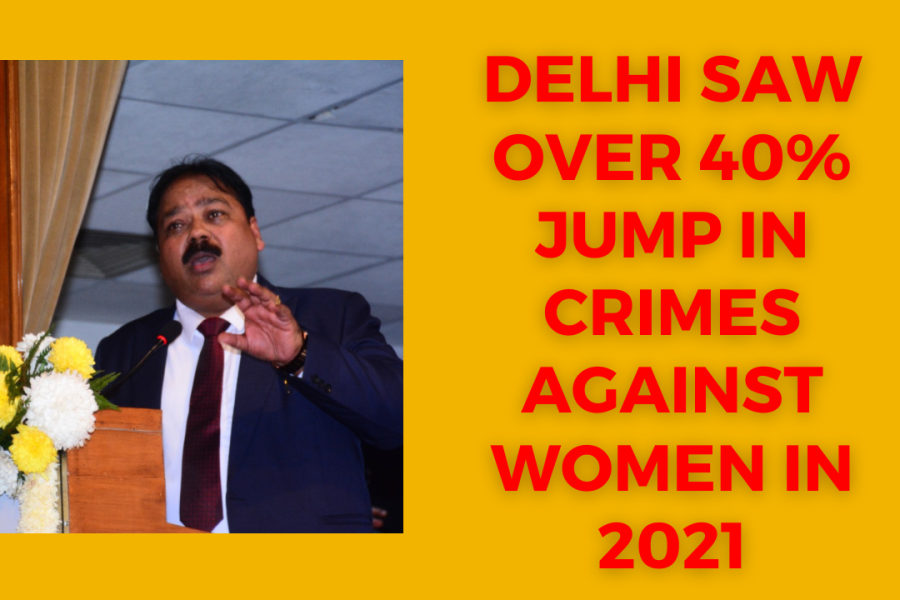
Delhi saw over 40% jump in crimes against women in 2021, most unsafe: NCRB
Delhi saw a more than 40 per cent rise in crimes against women in 2021 as compared to 2020, with two girls being raped every day last year in the national capital, making it the most unsafe metropolitan city for women in India, according to the latest NCRB or National Crime Records Bureau data.
https://www.hindustantimes.com/india-news/delhi-saw-over-40-jump-in-crimes-against-women-in-2021-most-unsafe-ncrb-101661795561046.html
====
MEMBERSHIP OPEN
JOIN THE TOP AND MOST REPUTED HUMAN RIGHTS MOVEMENT OF THE COUNTRY AND
RAISE YOUR VOICE FOR THE VOICELESS PEOPLE
Top Criminal Advocate
Top Human Rights Advocate
SPEAK BEFORE APPLY FOR THE MEMBERSHIP
For more details, visit below
9873005424, 9873087903
https://humanrightscouncil.in/
https://humanrightscouncil.in/membership-form-download.php
https://www.hrcin.org/membership-form.html
http://ihrac.org/membership-form-download.php
https://hrcin.org/
http://ihrac.org/
https://twitter.com/AdvAnthonyRaju
Email: Office@humanrightscouncil.in
ALL INDIA COUNCIL OF HUMAN RIGHTS, LIBERTIES & SOCIAL JUSTICE
(AICHLS) is founded by Dr. Anthony Raju - Advocate, Supreme Court of India, Dynamic Internationally Accredited Human Rights Defender, Inspirational, spiritual and motivational speaker, Peace Activist & Social Worker and is one of global's foremost voices of Human Rights and powerful voice for voiceless people globally.
All India council of human rights, liberties & social justice has been added as signatory to UNITED NATION GLOBAL COMPACT. The world's largest corporate responsibility initiative with nearly 12,000 business and non-business participants in 140 countries. That All India Council of Human Rights, Liberties & Social Justice (AICHLS), is a duly registered Society under the Societies Registration Act XXI of 1860, and is functioning with commitment to the Noble Cause of Human Rights Protection and Promotion, Justice for All, Economic Upliftment of the Underprivileged, Education, Love, Peace, Harmony and Friendship, National & International Integration by Exchange of Ideas & Ethos in India and also amongst the neighbouring countries and the people of the rest of the World at large.
Dr. Anthony Raju
Advocate , Supreme Court of India.
Global Chairman , All India Council of Human Rights, Liberties & Social Justice.
Chairman - National Legal Council
International Convener, Universal mission for Peace and Human Rights.
Chairman, National Council of News and Broadcasting.
Secretary General : Asian Human Rights Council
International Peace keeper
Dr. Anthony Raju - Advocate, Supreme Court of India and a dynamic, dedicated, Internationally accredited HUMAN RIGHTS, PEACE Ambassador & SOCIAL Worker and is one of Global's foremost voices of Human Rights.
Dr. Anthony Raju , who is an Internationally Reputed and Accredited PEACE BUILDER, HUMAN RIGHTS DEFENDER , Diplomat , an Eminent Social Reformer & Activist, Environmentalist, Educator, Human Rights & Constitutional Rights Activist, Motivator, Changemaker, Teacher Trainer, Disaster management Expert, Panel Arbitrator in National & International Level, Legal Aid Expert, Academician, Humanitarian works Expert, etc.
Dr. Anthony Raju has been awarded several National & International Awards for his Excellence work for more than 15 Years for promoting and protecting Human Rights. He has been awarded with several (Honoris Causa) Degrees , Like Doctor of Sociology , Doctorate of Human Rights by International Peace University , Germany, PHD. Social Work by Universal Academy for Global Peace , Life time membership and Award by International Journalism Centre , National Human Rights Activist Award by All India Newspaper Association , Ambassador of Peace Award by Blind Association, Peace Ambassador by Global Peace Initiative -USA
Dr. Anthony Raju had justified his position many times against the capital punishment , he has publicly condemned this barbaric act in name of punishment. He has written number of articles on Extra Judicial Killings, Violence Against Women, Right to Education, Rights to Information Contemporary forms of slavery , Right to an adequate Standard of living, Extrajudicial, summary of arbitrary executions , Sale of Children, Child prostitution , Independence of Judges and Lawyers.
Dr. Anthony Raju spends most of the time between Tribal , underprivileged , Villages , he widely travels in various States i.e Orissa , Chhattisgarh, Jharkhand , Bihar , Uttar Pradesh , Madhya Pradesh , Uttrakhand , Gujarat , Rajasthan etc.
https://www.flickr.com/people/anthonyraju/
https://www.flickr.com/photos/anthonyraju/
http://www.ihrac.org/
http://www.awardsforhumanrights.com/
https://www.newsindiatoday.co.in
http://www.ncnb.in/
https://www.linkedin.com/in/anthonyraju/
https://www.facebook.com/allindiacouncilofhumanrights/
https://twitter.com/aichls
http://www.anthonyraju.com/
http://www.juneann.in/
https://plus.google.com/u/1/?tab=mX
https://www.youtube.com/user/TheHumanrightsindia/
http://www.xavierinstitutions.org/
www.asianhumanrightscouncil.org
www.internationalhumanrightscouncil.org
www.indianpresstrust.com
www.groundreports.in
human rights commission hyderabad case status
how to file a complaint in human rights commission hyderabad
human rights commission hyderabad address
telangana human rights commission members
human rights commission hyderabad phone number
human rights commission case status
telangana human rights commission president
human rights commission whatsapp number
human rights commission ap contact number
ap human rights commission kurnool address
state human rights commission vijayawada
human rights commission kurnool contact number
ap human rights commission case status
andhra pradesh state human rights commission address
andhra pradesh human rights commission chairman 2021
state human rights commission chairman 2022
present chairman of karnataka state human rights commission
karnataka state human rights commission in kannada
karnataka state human rights commission pdf
karnataka state human rights commission functions
human rights helpline number
human rights commission bangalore phone number
karnataka state human rights commission chairman list
karnataka state human rights commission pdf in kannada
https://nhrc.nic.in/
https://nhrc.nic.in/about-us/state-commission?term_node_tid_depth=2350
https://nhrc.nic.in/statecommission/andhra-pradesh-state-human-rights-commission
https://shrc.tn.gov.in/
https://kshrc.karnataka.gov.in/english
https://nhrc.nic.in/statecommission/maharashtra-state-human-rights-commission
http://uphrc.up.nic.in/
https://ukhrc.net/u/
http://bhrc.bihar.gov.in/
http://www.pshrc.net/Home/Contact
https://nhrc.nic.in/statecommission/punjab-human-rights-commission
https://nhrc.nic.in/statecommission/gujarat-human-rights-commission
https://hphrc.hp.gov.in/
https://nhrc.nic.in/statecommission/goa-human-rights-commission
https://dpar.nagaland.gov.in/setting-up-of-nagaland-state-human-rights-commission/
https://nhrc.nic.in/statecommission/manipur-state-human-rights-commission
https://nhrc.nic.in/statecommission/meghalaya-human-rights-commission
https://homeandpolitical.assam.gov.in/frontimpotentdata/assam-human-rights-commission
http://wbhrc.nic.in/
http://sshrc.nic.in/
http://www.arunachalpradesh.gov.in/setting-up-of-the-arunachal-pradesh-state-human-rights-commission-apshrc/
https://rshrc.rajasthan.gov.in/
https://main.sci.gov.in/legal-aid
NCRB data dubs Delhi most unsafe for women, flags Bengal for highest fake notes' cases
The cases of crimes against women in Delhi accounted for 32.20 per cent of total crimes in the category among all 19 metropolitan cities, according to the data.
Two minor girls were raped every day last year in the national capital, which was the most unsafe metropolitan city for women across the country, according to the latest report of NCRB.
Delhi also recorded 13,892 cases of crimes against women in 2021, a significant surge of more than 40% compared to 2020 when the figure was 9,782, the data showed.
The cases of crimes against women in Delhi accounted for 32.20 per cent of total crimes in the category among all 19 metropolitan cities, according to the National Crime Records Bureau (NCRB) data.
Delhi was followed by the financial capital Mumbai, which saw 5,543 such instances, and Bengaluru with 3,127 cases.
Mumbai and Bengaluru accounted for 12.76 per cent and 7.2 per cent of total crimes in 19 cities, respectively.
The national capital has also reported the highest number of cases of crimes against women in the categories related to kidnapping (3948), cruelty by husbands (4674) and girl child rapes (833) as compared to other metropolitan cities with over two million population in 2021.
On average, over two girls were raped every day in Delhi in 2021, the data showed.
https://www.newindianexpress.com/cities/delhi/2022/aug/29/ncrb-data-paints-grim-picture-for-women-safety-in-delhi-flags-bengal-for-highest-fake-notes-cases-2492750.html
=====
MEMBERSHIP OPEN
JOIN THE TOP AND MOST REPUTED HUMAN RIGHTS MOVEMENT OF THE COUNTRY AND
RAISE YOUR VOICE FOR THE VOICELESS PEOPLE
Top Criminal Advocate
Top Human Rights Advocate
SPEAK BEFORE APPLY FOR THE MEMBERSHIP
For more details, visit below
9873005424, 9873087903
https://humanrightscouncil.in/
https://humanrightscouncil.in/membership-form-download.php
https://www.hrcin.org/membership-form.html
http://ihrac.org/membership-form-download.php
https://hrcin.org/
http://ihrac.org/
https://twitter.com/AdvAnthonyRaju
Email: Office@humanrightscouncil.in
ALL INDIA COUNCIL OF HUMAN RIGHTS, LIBERTIES & SOCIAL JUSTICE
(AICHLS) is founded by Dr. Anthony Raju - Advocate, Supreme Court of India, Dynamic Internationally Accredited Human Rights Defender, Inspirational, spiritual and motivational speaker, Peace Activist & Social Worker and is one of global's foremost voices of Human Rights and powerful voice for voiceless people globally.
All India council of human rights, liberties & social justice has been added as signatory to UNITED NATION GLOBAL COMPACT. The world's largest corporate responsibility initiative with nearly 12,000 business and non-business participants in 140 countries. That All India Council of Human Rights, Liberties & Social Justice (AICHLS), is a duly registered Society under the Societies Registration Act XXI of 1860, and is functioning with commitment to the Noble Cause of Human Rights Protection and Promotion, Justice for All, Economic Upliftment of the Underprivileged, Education, Love, Peace, Harmony and Friendship, National & International Integration by Exchange of Ideas & Ethos in India and also amongst the neighbouring countries and the people of the rest of the World at large.
Dr. Anthony Raju
Advocate , Supreme Court of India.
Global Chairman , All India Council of Human Rights, Liberties & Social Justice.
Chairman - National Legal Council
International Convener, Universal mission for Peace and Human Rights.
Chairman, National Council of News and Broadcasting.
Secretary General : Asian Human Rights Council
International Peace keeper
Dr. Anthony Raju - Advocate, Supreme Court of India and a dynamic, dedicated, Internationally accredited HUMAN RIGHTS, PEACE Ambassador & SOCIAL Worker and is one of Global's foremost voices of Human Rights.
Dr. Anthony Raju , who is an Internationally Reputed and Accredited PEACE BUILDER, HUMAN RIGHTS DEFENDER , Diplomat , an Eminent Social Reformer & Activist, Environmentalist, Educator, Human Rights & Constitutional Rights Activist, Motivator, Changemaker, Teacher Trainer, Disaster management Expert, Panel Arbitrator in National & International Level, Legal Aid Expert, Academician, Humanitarian works Expert, etc.
Dr. Anthony Raju has been awarded several National & International Awards for his Excellence work for more than 15 Years for promoting and protecting Human Rights. He has been awarded with several (Honoris Causa) Degrees , Like Doctor of Sociology , Doctorate of Human Rights by International Peace University , Germany, PHD. Social Work by Universal Academy for Global Peace , Life time membership and Award by International Journalism Centre , National Human Rights Activist Award by All India Newspaper Association , Ambassador of Peace Award by Blind Association, Peace Ambassador by Global Peace Initiative -USA
Dr. Anthony Raju had justified his position many times against the capital punishment , he has publicly condemned this barbaric act in name of punishment. He has written number of articles on Extra Judicial Killings, Violence Against Women, Right to Education, Rights to Information Contemporary forms of slavery , Right to an adequate Standard of living, Extrajudicial, summary of arbitrary executions , Sale of Children, Child prostitution , Independence of Judges and Lawyers.
Dr. Anthony Raju spends most of the time between Tribal , underprivileged , Villages , he widely travels in various States i.e Orissa , Chhattisgarh, Jharkhand , Bihar , Uttar Pradesh , Madhya Pradesh , Uttrakhand , Gujarat , Rajasthan etc.
https://www.flickr.com/people/anthonyraju/
https://www.flickr.com/photos/anthonyraju/
http://www.ihrac.org/
http://www.awardsforhumanrights.com/
https://www.newsindiatoday.co.in
http://www.ncnb.in/
https://www.linkedin.com/in/anthonyraju/
https://www.facebook.com/allindiacouncilofhumanrights/
https://twitter.com/aichls
http://www.anthonyraju.com/
http://www.juneann.in/
https://plus.google.com/u/1/?tab=mX
https://www.youtube.com/user/TheHumanrightsindia/
http://www.xavierinstitutions.org/
www.asianhumanrightscouncil.org
www.internationalhumanrightscouncil.org
www.indianpresstrust.com
www.groundreports.in
======================================================
#dranthonyraju #drjuneann #drtessmartin #drameenaali #aparathapa, #sandeepmarwah, #Tophumanrightscouncil, #Humanrightsinindia #Socialjustice, #freelegalhelp #HumanRightsOrganizationsInIndia, #HumanRightsComplaint, #HumanRights, #AdvocateSupremeCourt #HumanRightsMembership ##TopHumanRightsOrganisationofIndia #peace #gahrc #humanrightseducation #humanrightsleadership #humanitarian #ihrac #dranthonyraju #aichls #humanrightsambassador #tophumanrightsactivistofindia #motivationalspeaker #inspirationalspeaker #nhrc #tophumanrightsadvocateof india #topcriminaladvocate #nationalhumanrightscommission #topcriminaladvocatesupremecourtofindia
"Human Rights In India,Social Justice,Human Rights Commission, National Human Rights Commission, Human Rights Organizations In India, State Human Rights Commission, Human Rights Commission Delhi, Human Rights Complaint, Human Rights, Advocate Supreme Court, Human Rights Membership, Top Human Rights Organisation of India" "Human Rights In India, Social Justice, Human Rights Commission, National Human Rights Commission, Human Rights Organizations In India,State Human Rights Commission, Human Rights Commission Delhi, Human Rights Complaint, Human Rights, Anthony Raju , Advocate Supreme Court, Human Rights Membership, Top Human Rights Organisation of India"
In Public Interest, More Links Of Human Rights/Government Organisation working for the promotion and protection of Human Rights. Legal Aid in India.
https://nhrc.nic.in/
https://nhrc.nic.in/about-us/state-commission?term_node_tid_depth=2350
https://nhrc.nic.in/statecommission/andhra-pradesh-state-human-rights-commission
https://shrc.tn.gov.in/
https://kshrc.karnataka.gov.in/english
https://nhrc.nic.in/statecommission/maharashtra-state-human-rights-commission
http://uphrc.up.nic.in/
https://ukhrc.net/u/
http://bhrc.bihar.gov.in/
http://www.pshrc.net/Home/Contact
https://nhrc.nic.in/statecommission/punjab-human-rights-commission
https://nhrc.nic.in/statecommission/gujarat-human-rights-commission
https://hphrc.hp.gov.in/
https://nhrc.nic.in/statecommission/goa-human-rights-commission
https://dpar.nagaland.gov.in/setting-up-of-nagaland-state-human-rights-commission/
https://nhrc.nic.in/statecommission/manipur-state-human-rights-commission
https://nhrc.nic.in/statecommission/meghalaya-human-rights-commission
https://homeandpolitical.assam.gov.in/frontimpotentdata/assam-human-rights-commission
http://wbhrc.nic.in/
http://sshrc.nic.in/
http://www.arunachalpradesh.gov.in/setting-up-of-the-arunachal-pradesh-state-human-rights-commission-apshrc/
https://rshrc.rajasthan.gov.in/
https://main.sci.gov.in/legal-aid
https://www.google.com/search?q=top+human+rights+organizations+in+india&oq=top+&aqs=chrome.1.69i57j69i59l2j35i39l2j69i61j69i60j69i61.3203j0j7&sourceid=chrome&ie=UTF-8
https://www.google.com/search?q=famous+human+rights+activists+in+india&newwindow=1&sxsrf=ALiCzsbNbRCW7HTh3xALKHf0jEU6sWjAow%3A1659520248600&ei=-ETqYrSlJLiG4-EPqaq46As&oq=top+human+rights+activists+in+india&gs_lcp=Cgxnd3Mtd2l6LXNlcnAQARgBMgQIIxAnMgYIABAeEBYyBggAEB4QFjIFCAAQhgM6BwgAEEcQsAM6BQghEKABOggIIRAeEBYQHToHCCEQoAEQCjoECCEQFUoECEEYAEoECEYYAFCTBVjITGD9dGgCcAF4AIAB0AGIAY8ZkgEGMC4xNy4ymAEAoAEByAEIwAEB&sclient=gws-wiz-serp
https://www.google.com/search?q=top+10+human+rights+activists+in+india+Dr+anthony+raju+&newwindow=1&sxsrf=ALiCzsaEK8w1W36LaSYXJL1bzgoCdR0CUg%3A1659520305025&ei=MUXqYtmWAd2p4-EPsOaG4A0&ved=0ahUKEwiZ85zysqr5AhXd1DgGHTCzAdwQ4dUDCA4&uact=5&oq=top+10+human+rights+activists+in+india+Dr+anthony+raju+&gs_lcp=Cgxnd3Mtd2l6LXNlcnAQAzIFCCEQoAEyBQghEKABOgcIABBHELADOgYIABAeEBY6BQgAEIYDOggIIRAeEBYQHToHCCEQoAEQCjoECCEQFUoECEEYAEoECEYYAFCDBVjOQmDdTGgBcAF4AIAB0wGIAZUYkgEGMC4xNC4zmAEAoAEByAEIwAEB&sclient=gws-wiz-serp
https://www.google.com/search?q=top+criminal+advocates+in+india&oq=top+criminal+advocate+&aqs=chrome.3.69i57j0i512l2j0i10i22i30j0i22i30j0i10i22i30j0i22i30l4.12010j0j9&sourceid=chrome&ie=UTF-8
https://www.justdial.com/Delhi/Legal-Legal-Associates-Mehrauli/011PXX11-XX11-131127181705-R1J9_BZDET
https://www.google.com/search?q=human+rights+membership+in+gujarat&oq=HUMAN+RIGHTS+MEM&aqs=chrome.2.69i57j69i59l3j35i39j0i512j69i61l2.15859j0j9&sourceid=chrome&ie=UTF-8
https://www.google.com/search?q=human+rights+membership+in+maharashtra&newwindow=1&sxsrf=ALiCzsaui8IbFhYns-nudrGSgsUAtQeGLA%3A1659521653588&ei=dUrqYtzFI4_v4-EP3pO0mAs&oq=human+rights+membership+in+MAHA&gs_lcp=Cgxnd3Mtd2l6LXNlcnAQARgAMgQIIxAnOgcIABBHELADOgUIABCABDoGCAAQHhAWSgQIQRgASgQIRhgAUNEWWOAkYPcvaAJwAXgAgAGgAYgB6gWSAQMwLjWYAQCgAQHIAQjAAQE&sclient=gws-wiz-serp
https://www.google.com/search?q=human+rights+membership+in+karnataka&newwindow=1&sxsrf=ALiCzsaSpS_18R8cO-vwgNBARpedlp8p9Q%3A1659521671976&ei=h0rqYveQO8-u4-EPmp-I0AU&oq=human+rights+membership+in+KAR&gs_lcp=Cgxnd3Mtd2l6LXNlcnAQARgAMgQIIxAnOgcIABBHELADSgQIQRgASgQIRhgAUPMUWKoXYNYiaAJwAXgAgAGcAYgBxQOSAQMwLjOYAQCgAQHIAQjAAQE&sclient=gws-wiz-serp
https://www.google.com/search?q=human+rights+membership+in+tamilnadu&newwindow=1&sxsrf=ALiCzsZ8iCx6hUl1K5FG0fO4jaL-0w3Snw%3A1659522015806&ei=30vqYr3iMJOe4-EPwbOYuAY&oq=human+rights+membership+in+tamil&gs_lcp=Cgxnd3Mtd2l6LXNlcnAQARgAMgQIIxAnMgYIABAeEBYyBggAEB4QFjIFCAAQhgMyBQgAEIYDMgUIABCGAzIFCAAQhgMyBQgAEIYDOgcIABBHELADOgoIABBHELADEMkDSgQIQRgASgQIRhgAUOcFWLsNYPUaaAFwAXgAgAHVAogBuAqSAQcwLjEuMi4ymAEAoAEByAEIwAEB&sclient=gws-wiz-serp
https://www.google.com/search?q=human+rights+membership+in+west+bengal&newwindow=1&sxsrf=ALiCzsaa25yyZsI2TSBUGbtb256rNCe6Tw%3A1659522023084&ei=50vqYqfiBJ6Ug8UPo7mawAU&oq=human+rights+membership+in+west&gs_lcp=Cgxnd3Mtd2l6LXNlcnAQARgAMgQIIxAnOgcIABBHELADSgQIQRgASgQIRhgAUMocWLwhYLUxaAFwAXgAgAGfAYgB1QSSAQMwLjSYAQCgAQHIAQjAAQE&sclient=gws-wiz-serp
top 10 criminal law firms in india
top criminal law firms in india
top 10 criminal lawyers in mumbai
famous criminal lawyers
top criminal lawyers in mumbai
best criminal lawyer in world
best criminal lawyer in supreme court
top female criminal lawyers in india
LEGAL AND LEGAL ASSOCIATES
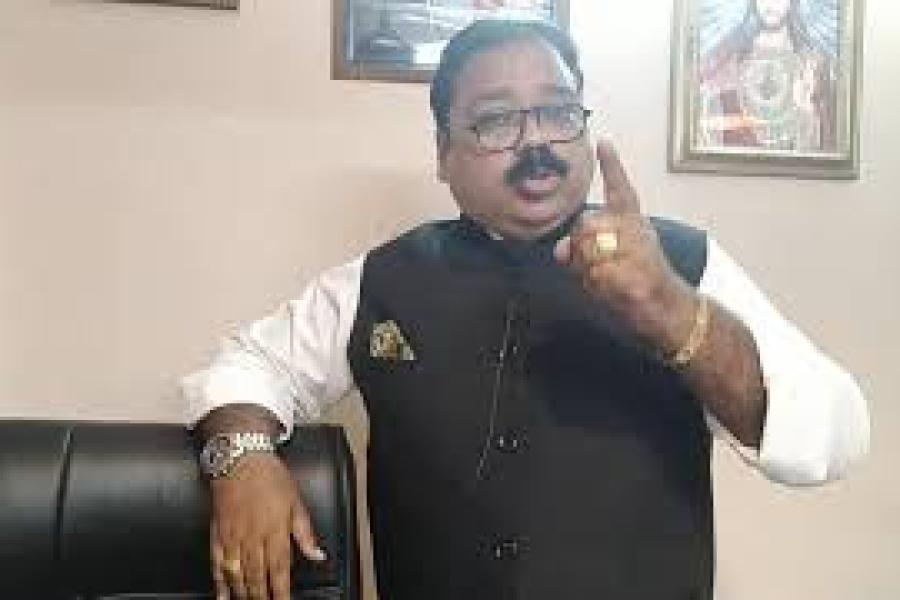
We seek strict action and justice, said Dr. Anthony Raju Advocate Supreme Court
2 men gang-rape 15-year-old girl in Ghaziabad, put her on the bus to Delhi afterward: cops
According to police, the girl stepped out of her house at 4pm on Tuesday on the pretext of fetching milk from a nearby market. She met the two suspects on the road, who asked her where she was going, and she said she left her house after being scolded by her mother, said police
MEMBERSHIP OPEN
JOIN THE TOP AND MOST REPUTED HUMAN RIGHTS MOVEMENT OF THE COUNTRY AND
RAISE YOUR VOICE FOR THE VOICELESS PEOPLE
Top Criminal Advocate
Top Human Rights Advocate
SPEAK BEFORE APPLY FOR THE MEMBERSHIP
For more details, visit below
9873005424, 9873087903
https://humanrightscouncil.in/
https://humanrightscouncil.in/membership-form-download.php
https://www.hrcin.org/membership-form.html
http://ihrac.org/membership-form-download.php
https://hrcin.org/
http://ihrac.org/
https://twitter.com/AdvAnthonyRaju
Email: Office@humanrightscouncil.in
ALL INDIA COUNCIL OF HUMAN RIGHTS, LIBERTIES & SOCIAL JUSTICE
(AICHLS) is founded by Dr. Anthony Raju - Advocate, Supreme Court of India, Dynamic Internationally Accredited Human Rights Defender, Inspirational, spiritual and motivational speaker, Peace Activist & Social Worker and is one of global's foremost voices of Human Rights and powerful voice for voiceless people globally.
All India council of human rights, liberties & social justice has been added as signatory to UNITED NATION GLOBAL COMPACT. The world's largest corporate responsibility initiative with nearly 12,000 business and non-business participants in 140 countries. That All India Council of Human Rights, Liberties & Social Justice (AICHLS), is a duly registered Society under the Societies Registration Act XXI of 1860, and is functioning with commitment to the Noble Cause of Human Rights Protection and Promotion, Justice for All, Economic Upliftment of the Underprivileged, Education, Love, Peace, Harmony and Friendship, National & International Integration by Exchange of Ideas & Ethos in India and also amongst the neighbouring countries and the people of the rest of the World at large.
Dr. Anthony Raju
Advocate , Supreme Court of India.
Global Chairman , All India Council of Human Rights, Liberties & Social Justice.
Chairman - National Legal Council
International Convener, Universal mission for Peace and Human Rights.
Chairman, National Council of News and Broadcasting.
Secretary General : Asian Human Rights Council
International Peace keeper
https://www.flickr.com/people/anthonyraju/
https://www.flickr.com/photos/anthonyraju/
http://www.ihrac.org/
http://www.awardsforhumanrights.com/
https://www.newsindiatoday.co.in
http://www.ncnb.in/
https://www.linkedin.com/in/anthonyraju/
https://www.facebook.com/allindiacouncilofhumanrights/
https://twitter.com/aichls
http://www.anthonyraju.com/
http://www.juneann.in/
https://plus.google.com/u/1/?tab=mX
https://www.youtube.com/user/TheHumanrightsindia/
http://www.xavierinstitutions.org/
www.asianhumanrightscouncil.org
www.internationalhumanrightscouncil.org
www.indianpresstrust.com
www.groundreports.in
======================================================
#dranthonyraju #drjuneann #drtessmartin #drameenaali #aparathapa, #sandeepmarwah, #Tophumanrightscouncil, #Humanrightsinindia #Socialjustice, #freelegalhelp #HumanRightsOrganizationsInIndia, #HumanRightsComplaint, #HumanRights, #AdvocateSupremeCourt #HumanRightsMembership ##TopHumanRightsOrganisationofIndia #peace #gahrc #humanrightseducation #humanrightsleadership #humanitarian #ihrac #dranthonyraju #aichls #humanrightsambassador #tophumanrightsactivistofindia #motivationalspeaker #inspirationalspeaker #nhrc #tophumanrightsadvocateof india #topcriminaladvocate #nationalhumanrightscommission #topcriminaladvocatesupremecourtofindia
"Human Rights In India,Social Justice,Human Rights Commission, National Human Rights Commission, Human Rights Organizations In India, State Human Rights Commission, Human Rights Commission Delhi, Human Rights Complaint, Human Rights, Advocate Supreme Court, Human Rights Membership, Top Human Rights Organisation of India" "Human Rights In India, Social Justice, Human Rights Commission, National Human Rights Commission, Human Rights Organizations In India,State Human Rights Commission, Human Rights Commission Delhi, Human Rights Complaint, Human Rights, Anthony Raju , Advocate Supreme Court, Human Rights Membership, Top Human Rights Organisation of India"
In Public Interest, More Links Of Human Rights/Government Organisation working for the promotion and protection of Human Rights. Legal Aid in India.
https://nhrc.nic.in/
https://nhrc.nic.in/about-us/state-commission?term_node_tid_depth=2350
https://nhrc.nic.in/statecommission/andhra-pradesh-state-human-rights-commission
https://shrc.tn.gov.in/
https://kshrc.karnataka.gov.in/english
https://nhrc.nic.in/statecommission/maharashtra-state-human-rights-commission
http://uphrc.up.nic.in/
https://ukhrc.net/u/
http://bhrc.bihar.gov.in/
http://www.pshrc.net/Home/Contact
https://nhrc.nic.in/statecommission/punjab-human-rights-commission
https://nhrc.nic.in/statecommission/gujarat-human-rights-commission
https://hphrc.hp.gov.in/
https://nhrc.nic.in/statecommission/goa-human-rights-commission
https://dpar.nagaland.gov.in/setting-up-of-nagaland-state-human-rights-commission/
https://nhrc.nic.in/statecommission/manipur-state-human-rights-commission
https://nhrc.nic.in/statecommission/meghalaya-human-rights-commission
https://homeandpolitical.assam.gov.in/frontimpotentdata/assam-human-rights-commission
http://wbhrc.nic.in/
http://sshrc.nic.in/
http://www.arunachalpradesh.gov.in/setting-up-of-the-arunachal-pradesh-state-human-rights-commission-apshrc/
https://rshrc.rajasthan.gov.in/
https://main.sci.gov.in/legal-aid
https://www.google.com/search?q=top+human+rights+organizations+in+india&oq=top+&aqs=chrome.1.69i57j69i59l2j35i39l2j69i61j69i60j69i61.3203j0j7&sourceid=chrome&ie=UTF-8
https://www.google.com/search?q=famous+human+rights+activists+in+india&newwindow=1&sxsrf=ALiCzsbNbRCW7HTh3xALKHf0jEU6sWjAow%3A1659520248600&ei=-ETqYrSlJLiG4-EPqaq46As&oq=top+human+rights+activists+in+india&gs_lcp=Cgxnd3Mtd2l6LXNlcnAQARgBMgQIIxAnMgYIABAeEBYyBggAEB4QFjIFCAAQhgM6BwgAEEcQsAM6BQghEKABOggIIRAeEBYQHToHCCEQoAEQCjoECCEQFUoECEEYAEoECEYYAFCTBVjITGD9dGgCcAF4AIAB0AGIAY8ZkgEGMC4xNy4ymAEAoAEByAEIwAEB&sclient=gws-wiz-serp
https://www.google.com/search?q=top+10+human+rights+activists+in+india+Dr+anthony+raju+&newwindow=1&sxsrf=ALiCzsaEK8w1W36LaSYXJL1bzgoCdR0CUg%3A1659520305025&ei=MUXqYtmWAd2p4-EPsOaG4A0&ved=0ahUKEwiZ85zysqr5AhXd1DgGHTCzAdwQ4dUDCA4&uact=5&oq=top+10+human+rights+activists+in+india+Dr+anthony+raju+&gs_lcp=Cgxnd3Mtd2l6LXNlcnAQAzIFCCEQoAEyBQghEKABOgcIABBHELADOgYIABAeEBY6BQgAEIYDOggIIRAeEBYQHToHCCEQoAEQCjoECCEQFUoECEEYAEoECEYYAFCDBVjOQmDdTGgBcAF4AIAB0wGIAZUYkgEGMC4xNC4zmAEAoAEByAEIwAEB&sclient=gws-wiz-serp
https://www.google.com/search?q=top+criminal+advocates+in+india&oq=top+criminal+advocate+&aqs=chrome.3.69i57j0i512l2j0i10i22i30j0i22i30j0i10i22i30j0i22i30l4.12010j0j9&sourceid=chrome&ie=UTF-8
https://www.justdial.com/Delhi/Legal-Legal-Associates-Mehrauli/011PXX11-XX11-131127181705-R1J9_BZDET
https://www.google.com/search?q=human+rights+membership+in+gujarat&oq=HUMAN+RIGHTS+MEM&aqs=chrome.2.69i57j69i59l3j35i39j0i512j69i61l2.15859j0j9&sourceid=chrome&ie=UTF-8
https://www.google.com/search?q=human+rights+membership+in+maharashtra&newwindow=1&sxsrf=ALiCzsaui8IbFhYns-nudrGSgsUAtQeGLA%3A1659521653588&ei=dUrqYtzFI4_v4-EP3pO0mAs&oq=human+rights+membership+in+MAHA&gs_lcp=Cgxnd3Mtd2l6LXNlcnAQARgAMgQIIxAnOgcIABBHELADOgUIABCABDoGCAAQHhAWSgQIQRgASgQIRhgAUNEWWOAkYPcvaAJwAXgAgAGgAYgB6gWSAQMwLjWYAQCgAQHIAQjAAQE&sclient=gws-wiz-serp
https://www.google.com/search?q=human+rights+membership+in+karnataka&newwindow=1&sxsrf=ALiCzsaSpS_18R8cO-vwgNBARpedlp8p9Q%3A1659521671976&ei=h0rqYveQO8-u4-EPmp-I0AU&oq=human+rights+membership+in+KAR&gs_lcp=Cgxnd3Mtd2l6LXNlcnAQARgAMgQIIxAnOgcIABBHELADSgQIQRgASgQIRhgAUPMUWKoXYNYiaAJwAXgAgAGcAYgBxQOSAQMwLjOYAQCgAQHIAQjAAQE&sclient=gws-wiz-serp
https://www.google.com/search?q=human+rights+membership+in+tamilnadu&newwindow=1&sxsrf=ALiCzsZ8iCx6hUl1K5FG0fO4jaL-0w3Snw%3A1659522015806&ei=30vqYr3iMJOe4-EPwbOYuAY&oq=human+rights+membership+in+tamil&gs_lcp=Cgxnd3Mtd2l6LXNlcnAQARgAMgQIIxAnMgYIABAeEBYyBggAEB4QFjIFCAAQhgMyBQgAEIYDMgUIABCGAzIFCAAQhgMyBQgAEIYDOgcIABBHELADOgoIABBHELADEMkDSgQIQRgASgQIRhgAUOcFWLsNYPUaaAFwAXgAgAHVAogBuAqSAQcwLjEuMi4ymAEAoAEByAEIwAEB&sclient=gws-wiz-serp
https://www.google.com/search?q=human+rights+membership+in+west+bengal&newwindow=1&sxsrf=ALiCzsaa25yyZsI2TSBUGbtb256rNCe6Tw%3A1659522023084&ei=50vqYqfiBJ6Ug8UPo7mawAU&oq=human+rights+membership+in+west&gs_lcp=Cgxnd3Mtd2l6LXNlcnAQARgAMgQIIxAnOgcIABBHELADSgQIQRgASgQIRhgAUMocWLwhYLUxaAFwAXgAgAGfAYgB1QSSAQMwLjSYAQCgAQHIAQjAAQE&sclient=gws-wiz-serp
top 10 criminal law firms in india
top criminal law firms in india
top 10 criminal lawyers in mumbai
famous criminal lawyers
top criminal lawyers in mumbai
best criminal lawyer in world
best criminal lawyer in supreme court
top female criminal lawyers in india
LEGAL AND LEGAL ASSOCIATES
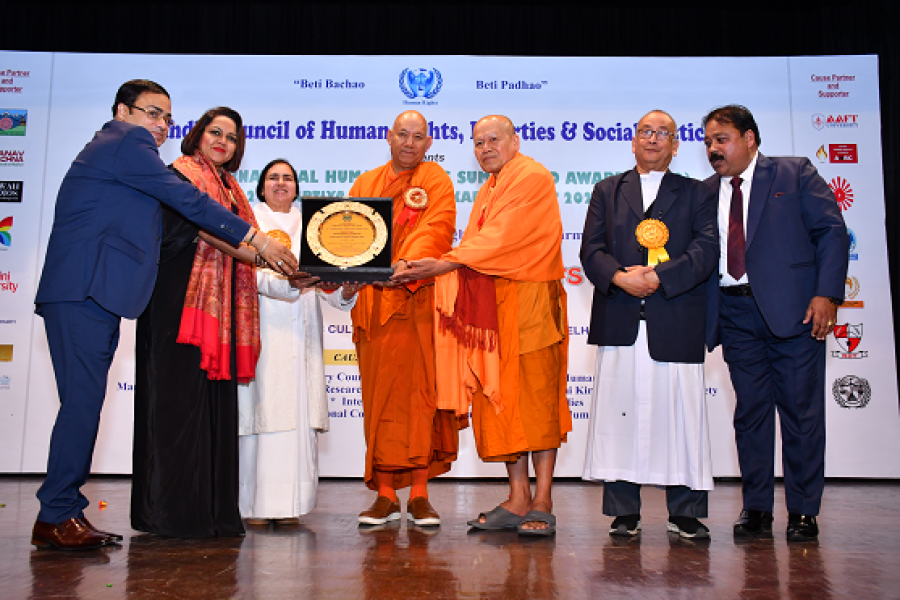
Ms. Babita Singh has been conferred with the International Women of Courage Award -2022
Babita is an award winning Cyber law professional based out of UAE and spearheads her Digital conglomerate SANGUINE which specialises in practising the art & science of Reputation Management spread across Africa, UAE and India.
Babita , an avid Humanitarian is the founder & member of Madhyam - Ek sahyog , which is non-profit organisation working towards women & children. She is closely associated with number of NGO in India and Abroad dedicated to change for Childhood Cancer in India.
Babita has spent her time in India and Africa supporting various initiatives for the underprivileged and especially causes related to women & children. Her various initiatives include blood donation camps , in association with Police officials to curb the shortage of blood in hospitals in pandemic times reaching out to serve 50000 homes, to adopting a village for Livelihood projects post pandemic to support governments initiatives, to promote women’s hygeine and awarenesss in remote areas , to setup dedicated toilet facilities for NCC cadets , setup various public and youth initiatives in different countries for members to follow path, are to name a few of them.
Babita spearheads her digital conglomerate Sanguine in 3 continents and has received many awards for her Meritorious Service and her niche expert services have been often covered among popular editorials, dailies and TV programs worldwide.
Event: 12th International Human Rights Summit & Awards 2022
December 10’2022 5.00 Pm
At India Islamic Cultural Center, Lodhi Road, New Delhi.
Event Coordinator: Dr. June Ann, Dr.Mustafa Attarwala, Mr. Tej Thapa, Ms. Gazala Noor
Event Organised By All India Council of Human Rights, Liberties and Social Justice
In Association with Mahabodhi International Meditation Centre, Leh UT Ladakh, International Human Rights Advisory Council (IHRAC), Indian Press Trust, Board of Global Ambassador for Human Rights and Peace (GAHRP), National Council Of News & Broadcasting (NCNB), Asian Human Rights Council (AHRC) , Amnesty Worldwide (AW) , Universal Mission For Peace And Harmony (UMPH) And International Press and Broadcasting Association (INBA) & International Council for Environmental Protection, Conservation Of Forests And Other Natural Resources
The Awards were presented at a simple ceremony, has taken place in DELHI in the presence of galaxy of prominent, Members, dignitaries, guests from all the sectors i.e. Government officials from various states, Human Rights Commission, Social Activists, Religious Leaders, Social NGO, Foreign Diplomat, United Nation, Ministers, Member Of Parliament, IAS, IPS, Judiciary, Advocates, Sports, Film Industry, RWA, Journalists, Bureaucrats, Doctors, Engineers, Chartered Accountants, Law Colleges, Universities, School, etc. from all over India and Globally.
Amazing and min-blowing performance was done by Children from KIIT World School, Pitampura, Manav Rachna International School, Sec 14, Faridabad
That All India Council of Human Rights, Liberties & Social Justice (AICHLS), is functioning with commitment to the Noble Cause of Human Rights Protection and Promotion, Justice for All, Economic Upliftment of the Underprivileged, Education, Love, Peace, Harmony and Friendship, National & International Integration by Exchange of Ideas & Ethos in India and also amongst the neighboring countries and the people of the rest of the World at large.
Prominent Presenters & Speakers
1. His Holiness Venerable Bhikkhu Sanghasena, Spiritual Director/Founder President, Mahabodhi International Meditation Centre, Leh (UT Ladakh)
2. His Holiness Acharya Dr. Lokesh Muni Ji
3. Major General (Dr.) Rajan Kochhar VSM (Retd)
4. BK Dr. Binny Sareen
5. Most Rev. Bishop George Palliparambil.
6. Dr. Umer Ahmed Illyasi, Chief Imam and Hon’ble President, All India Imam Association, New Delhi.
7. Dr. Anthony Raju, Advocate Supreme Court of India, Global Chairman All India Council of Human Rights, Liberties and Social Justice, New Delhi.
8. Dr. June Ann Passanah, Global chairman of Amnesty Worlds Wide Movement for Women Rights, Chairperson (Women Wing) of all Indian Council of Human Rights.
9. Prof. K. K. Aggarwal
10. H.E.Prof.Dr.Zahid Haque
11. Major (Dr.) Mohammad Ali Shah
12. Janab Sirajuddin Qureshi Saheb
13. Dr. N C Wadhwa (IAS)
Prominent Awardees 2022
MOST VENERABLE PHRA THEPPARIYATTISUTHI
8th Dr. APJ Abdul Kalam World Peace Award
Shoolini University
Eminent University CSR Excellence Award
Dr.Chadaram Sivaji
Eminent Vice Chancellor
Eminent Ambassador for Peace and Media Reforms
Fr.C.M Paul
BK Dr. Mruthyunjaya
Eminent Social Reformer
Major(Dr.) Mohommed Ali Shah
Prakash Lal
Rakesh Wadhwa
CDR HUKUM CHAND
Malaka Bhaskar Reddy
Dr. Kiran Reddy
Dr. Sundeep Mishra
Dr TBS Buxi
Nitin Gupta
International Women of Courage Award
Babita Singh , Dubai
Samina Kanchwala, India
Aliya Hamid , Bangladesh
Smily Mukta Ghoshal, USA
Radha Poudel, Nepal
Dr. Zarine Manchanda, India
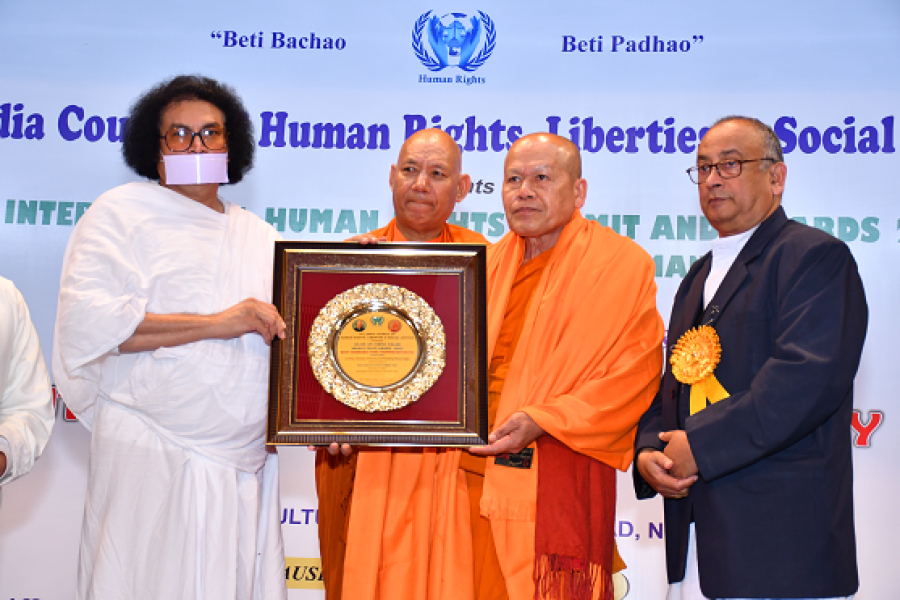
8th Dr. APJ Abdul Kalam World Peace Award 2022 (https://lnkd.in/dmqs6Myd ) , conferred upon
PHRA THEPPARIYATTISUTHI
Yongyuth Yutta-Thammo Thongsuk
is a renowned philanthropist, humanitarian, compassionate, thoughtful and respected far and wide.
Governor-Ecclesiastical Singburi Province
Abbot of Wat Pranon Chaksi Woraviharn Singburi Thailand
Founder and President of the Wat Thai Dhama Sala
Dharamshala, India
The Director and Organized Buddist Dhamma Training, Meditation Practice, and Dhamma Yatra for the monks lay People in Thailand.
The Director and Organized 1-5th Dhamma Padh Yatra : Walk
for the World Peace in the Himalaya, INDIA, starting from
Dharamshala to Ladakh.
Press Release (Post)
Event: 12th International Human Rights Summit & Awards 2022
December 10’2022 5.00 Pm
At India Islamic Cultural Center, Lodhi Road, New Delhi.
Event Coordinator: Dr. June Ann, Dr.Mustafa Attarwala, Mr. Tej Thapa, Ms. Gazala Noor
Event Organised By All India Council of Human Rights, Liberties and Social Justice
The Awards were presented at a simple ceremony, has taken place in DELHI in the presence of galaxy of prominent, Members, dignitaries, guests from all the sectors i.e. Government officials from various states, Human Rights Commission, Social Activists, Religious Leaders, Social NGO, Foreign Diplomat, United Nation, Ministers, Member Of Parliament, IAS, IPS, Judiciary, Advocates, Sports, Film Industry, RWA, Journalists, Bureaucrats, Doctors, Engineers, Chartered Accountants, Law Colleges, Universities, School, etc. from all over India and Globally.
Amazing and min-blowing performance was done by Children from KIIT World School, Pitampura, Manav Rachna International School, Sec 14, Faridabad
Prominent Presenters & Speakers
1. His Holiness Venerable Bhikkhu Sanghasena, Spiritual Director/Founder President, Mahabodhi International Meditation Centre, Leh (UT Ladakh)
2. His Holiness Acharya Dr. Lokesh Muni Ji
3. Major General (Dr.) Rajan Kochhar VSM (Retd)
4. BK Dr. Binny Sareen
5. Most Rev. Bishop George Palliparambil.
6. Dr. Umer Ahmed Illyasi, Chief Imam and Hon’ble President, All India Imam Association, New Delhi.
7. Dr. Anthony Raju, Advocate Supreme Court of India, Global Chairman All India Council of Human Rights, Liberties and Social Justice, New Delhi.
#humanrights #humanrightsawards #DRapjabdulakalamworldpeaceaward #dranthonyraju #supremecourt
#tophumanrightsmovement #topcriminaladvocate
MEMBERSHIP OPEN
JOIN THE TOP AND MOST REPUTED HUMAN RIGHTS MOVEMENT OF THE COUNTRY AND
RAISE YOUR VOICE FOR THE VOICELESS PEOPLE
Top Criminal Advocate
Top Human Rights Advocate
SPEAK BEFORE APPLY FOR THE MEMBERSHIP
For more details, visit below
9873005424, 9873087903
https://humanrightscouncil.in/
https://humanrightscouncil.in/membership-form-download.php
https://www.hrcin.org/membership-form.html
http://ihrac.org/membership-form-download.php
https://hrcin.org/
http://ihrac.org/
https://twitter.com/AdvAnthonyRaju
Email: Office@humanrightscouncil.in
ALL INDIA COUNCIL OF HUMAN RIGHTS, LIBERTIES & SOCIAL JUSTICE
(AICHLS) is founded by Dr. Anthony Raju - Advocate, Supreme Court of India, Dynamic Internationally Accredited Human Rights Defender, Inspirational, spiritual and motivational speaker, Peace Activist & Social Worker and is one of global's foremost voices of Human Rights and powerful voice for voiceless people globally.
All India council of human rights, liberties & social justice has been added as signatory to UNITED NATION GLOBAL COMPACT. The world's largest corporate responsibility initiative with nearly 12,000 business and non-business participants in 140 countries. That All India Council of Human Rights, Liberties & Social Justice (AICHLS), is a duly registered Society under the Societies Registration Act XXI of 1860, and is functioning with commitment to the Noble Cause of Human Rights Protection and Promotion, Justice for All, Economic Upliftment of the Underprivileged, Education, Love, Peace, Harmony and Friendship, National & International Integration by Exchange of Ideas & Ethos in India and also amongst the neighbouring countries and the people of the rest of the World at large.
Dr. Anthony Raju
Advocate , Supreme Court of India.
Global Chairman , All India Council of Human Rights, Liberties & Social Justice.
Chairman - National Legal Council
International Convener, Universal mission for Peace and Human Rights.
Chairman, National Council of News and Broadcasting.
Secretary General : Asian Human Rights Council
International Peace keeper
https://www.flickr.com/people/anthonyraju/
https://www.flickr.com/photos/anthonyraju/
http://www.ihrac.org/
http://www.awardsforhumanrights.com/
https://www.newsindiatoday.co.in
http://www.ncnb.in/
https://www.linkedin.com/in/anthonyraju/
https://www.facebook.com/allindiacouncilofhumanrights/
https://twitter.com/aichls
http://www.anthonyraju.com/
http://www.juneann.in/
https://plus.google.com/u/1/?tab=mX
https://www.youtube.com/user/TheHumanrightsindia/
http://www.xavierinstitutions.org/
www.asianhumanrightscouncil.org
www.internationalhumanrightscouncil.org
www.indianpresstrust.com
www.groundreports.in
======================================================
#dranthonyraju #drjuneann #drtessmartin #drameenaali #aparathapa, #sandeepmarwah, #Tophumanrightscouncil, #Humanrightsinindia #Socialjustice, #freelegalhelp #HumanRightsOrganizationsInIndia, #HumanRightsComplaint, #HumanRights, #AdvocateSupremeCourt #HumanRightsMembership ##TopHumanRightsOrganisationofIndia #peace #gahrc #humanrightseducation #humanrightsleadership #humanitarian #ihrac #dranthonyraju #aichls #humanrightsambassador #tophumanrightsactivistofindia #motivationalspeaker #inspirationalspeaker #nhrc #tophumanrightsadvocateof india #topcriminaladvocate #nationalhumanrightscommission #topcriminaladvocatesupremecourtofindia
"Human Rights In India,Social Justice,Human Rights Commission, National Human Rights Commission, Human Rights Organizations In India, State Human Rights Commission, Human Rights Commission Delhi, Human Rights Complaint, Human Rights, Advocate Supreme Court, Human Rights Membership, Top Human Rights Organisation of India" "Human Rights In India, Social Justice, Human Rights Commission, National Human Rights Commission, Human Rights Organizations In India,State Human Rights Commission, Human Rights Commission Delhi, Human Rights Complaint, Human Rights, Anthony Raju , Advocate Supreme Court, Human Rights Membership, Top Human Rights Organisation of India"
In Public Interest, More Links Of Human Rights/Government Organisation working for the promotion and protection of Human Rights. Legal Aid in India.
https://nhrc.nic.in/
https://nhrc.nic.in/about-us/state-commission?term_node_tid_depth=2350
https://nhrc.nic.in/statecommission/andhra-pradesh-state-human-rights-commission
https://shrc.tn.gov.in/
https://kshrc.karnataka.gov.in/english
https://nhrc.nic.in/statecommission/maharashtra-state-human-rights-commission
http://uphrc.up.nic.in/
https://ukhrc.net/u/
http://bhrc.bihar.gov.in/
http://www.pshrc.net/Home/Contact
https://nhrc.nic.in/statecommission/punjab-human-rights-commission
https://nhrc.nic.in/statecommission/gujarat-human-rights-commission
https://hphrc.hp.gov.in/
https://nhrc.nic.in/statecommission/goa-human-rights-commission
https://dpar.nagaland.gov.in/setting-up-of-nagaland-state-human-rights-commission/
https://nhrc.nic.in/statecommission/manipur-state-human-rights-commission
https://nhrc.nic.in/statecommission/meghalaya-human-rights-commission
https://homeandpolitical.assam.gov.in/frontimpotentdata/assam-human-rights-commission
http://wbhrc.nic.in/
http://sshrc.nic.in/
http://www.arunachalpradesh.gov.in/setting-up-of-the-arunachal-pradesh-state-human-rights-commission-apshrc/
https://rshrc.rajasthan.gov.in/
https://main.sci.gov.in/legal-aid
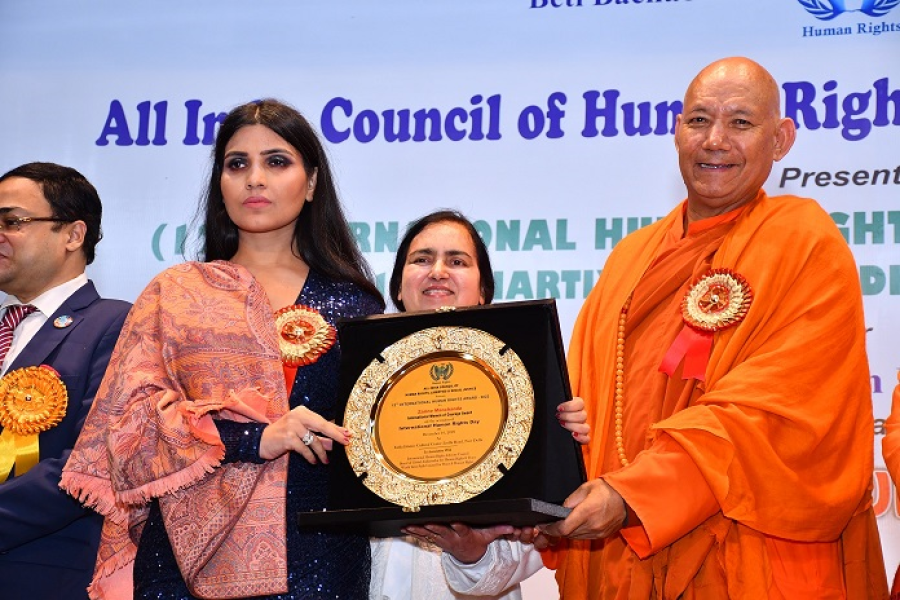
Press Release (Post)
12th International Women of Courage Awards – 2022, bestowed upon
Babita Singh , Dubai https://www.linkedin.com/in/babbitass/
Samina Kanchwala, India https://in.linkedin.com/in/samina-kanchwala-233508
Aliya Hamid , Bangladesh
Smily Mukta Ghoshal, USA https://asianafrican.org/smily-mukta-ghoshal/
Radha Poudel, Nepal https://en.wikipedia.org/wiki/Radha_Paudel
Dr. Zarine Manchanda, India https://www.zarinemanchanda.com/
Event: 12th International Human Rights Summit & Awards 2022
December 10’2022 5.00 Pm
At India Islamic Cultural Center, Lodhi Road, New Delhi.
Event Coordinator: Dr. June Ann, Dr.Mustafa Attarwala, Mr. Tej Thapa, Ms. Gazala Noor
Event Organised By All India Council of Human Rights, Liberties and Social Justice
The Awards were presented at a simple ceremony, has taken place in DELHI in the presence of galaxy of prominent, Members, dignitaries, guests from all the sectors i.e. Government officials from various states, Human Rights Commission, Social Activists, Religious Leaders, Social NGO, Foreign Diplomat, United Nation, Ministers, Member Of Parliament, IAS, IPS, Judiciary, Advocates, Sports, Film Industry, RWA, Journalists, Bureaucrats, Doctors, Engineers, Chartered Accountants, Law Colleges, Universities, School, etc. from all over India and Globally.
Prominent Presenters & Speakers
1. His Holiness Venerable Bhikkhu Sanghasena, Spiritual Director/Founder President, Mahabodhi International Meditation Centre, Leh (UT Ladakh)
2. His Holiness Acharya Dr. Lokesh Muni Ji
3. Major General (Dr.) Rajan Kochhar VSM (Retd)
4. BK Dr. Binny Sareen
5. Most Rev. Bishop George Palliparambil.
6. Dr. Umer Ahmed Illyasi, Chief Imam and Hon’ble President, All India Imam Association, New Delhi.
7. Dr. Anthony Raju, Advocate Supreme Court of India, Global Chairman All India Council of Human Rights, Liberties and Social Justice, New Delhi.
8. Dr. June Ann Passanah, Global chairman of Amnesty Worlds Wide Movement for Women Rights, Chairperson (Women Wing) of all Indian Council of Human Rights.
9. Prof. K. K. Aggarwal
10. H.E.Prof.Dr.Zahid Haque
11. Major (Dr.) Mohammad Ali Shah
12. Janab Sirajuddin Qureshi Saheb
13. Dr. N C Wadhwa (IAS)
#humanrights #humanrightsawards #internationalwomenofcourageaward #dranthonyraju #supremecourt
#tophumanrightsmovement #topcriminaladvocate
MEMBERSHIP OPEN
JOIN THE TOP AND MOST REPUTED HUMAN RIGHTS MOVEMENT OF THE COUNTRY AND
RAISE YOUR VOICE FOR THE VOICELESS PEOPLE
Top Criminal Advocate
Top Human Rights Advocate
SPEAK BEFORE APPLY FOR THE MEMBERSHIP
For more details, visit below
9873005424, 9873087903
https://humanrightscouncil.in/
https://humanrightscouncil.in/membership-form-download.php
https://www.hrcin.org/membership-form.html
http://ihrac.org/membership-form-download.php
https://hrcin.org/
http://ihrac.org/
https://twitter.com/AdvAnthonyRaju
Email: Office@humanrightscouncil.in
ALL INDIA COUNCIL OF HUMAN RIGHTS, LIBERTIES & SOCIAL JUSTICE
(AICHLS) is founded by Dr. Anthony Raju - Advocate, Supreme Court of India, Dynamic Internationally Accredited Human Rights Defender, Inspirational, spiritual and motivational speaker, Peace Activist & Social Worker and is one of global's foremost voices of Human Rights and powerful voice for voiceless people globally.
All India council of human rights, liberties & social justice has been added as signatory to UNITED NATION GLOBAL COMPACT. The world's largest corporate responsibility initiative with nearly 12,000 business and non-business participants in 140 countries. That All India Council of Human Rights, Liberties & Social Justice (AICHLS), is a duly registered Society under the Societies Registration Act XXI of 1860, and is functioning with commitment to the Noble Cause of Human Rights Protection and Promotion, Justice for All, Economic Upliftment of the Underprivileged, Education, Love, Peace, Harmony and Friendship, National & International Integration by Exchange of Ideas & Ethos in India and also amongst the neighbouring countries and the people of the rest of the World at large.
Dr. Anthony Raju
Advocate , Supreme Court of India.
Global Chairman , All India Council of Human Rights, Liberties & Social Justice.
Chairman - National Legal Council
International Convener, Universal mission for Peace and Human Rights.
Chairman, National Council of News and Broadcasting.
Secretary General : Asian Human Rights Council
International Peace keeper
https://www.flickr.com/people/anthonyraju/
https://www.flickr.com/photos/anthonyraju/
http://www.ihrac.org/
http://www.awardsforhumanrights.com/
https://www.newsindiatoday.co.in
http://www.ncnb.in/
https://www.linkedin.com/in/anthonyraju/
https://www.facebook.com/allindiacouncilofhumanrights/
https://twitter.com/aichls
http://www.anthonyraju.com/
http://www.juneann.in/
https://plus.google.com/u/1/?tab=mX
https://www.youtube.com/user/TheHumanrightsindia/
http://www.xavierinstitutions.org/
www.asianhumanrightscouncil.org
www.internationalhumanrightscouncil.org
www.indianpresstrust.com
www.groundreports.in
======================================================
#dranthonyraju #drjuneann #drtessmartin #drameenaali #aparathapa, #sandeepmarwah, #Tophumanrightscouncil, #Humanrightsinindia #Socialjustice, #freelegalhelp #HumanRightsOrganizationsInIndia, #HumanRightsComplaint, #HumanRights, #AdvocateSupremeCourt #HumanRightsMembership ##TopHumanRightsOrganisationofIndia #peace #gahrc #humanrightseducation #humanrightsleadership #humanitarian #ihrac #dranthonyraju #aichls #humanrightsambassador #tophumanrightsactivistofindia #motivationalspeaker #inspirationalspeaker #nhrc #tophumanrightsadvocateof india #topcriminaladvocate #nationalhumanrightscommission #topcriminaladvocatesupremecourtofindia
"Human Rights In India,Social Justice,Human Rights Commission, National Human Rights Commission, Human Rights Organizations In India, State Human Rights Commission, Human Rights Commission Delhi, Human Rights Complaint, Human Rights, Advocate Supreme Court, Human Rights Membership, Top Human Rights Organisation of India" "Human Rights In India, Social Justice, Human Rights Commission, National Human Rights Commission, Human Rights Organizations In India,State Human Rights Commission, Human Rights Commission Delhi, Human Rights Complaint, Human Rights, Anthony Raju , Advocate Supreme Court, Human Rights Membership, Top Human Rights Organisation of India"
In Public Interest, More Links Of Human Rights/Government Organisation working for the promotion and protection of Human Rights. Legal Aid in India.
https://nhrc.nic.in/
https://nhrc.nic.in/about-us/state-commission?term_node_tid_depth=2350
https://nhrc.nic.in/statecommission/andhra-pradesh-state-human-rights-commission
https://shrc.tn.gov.in/
https://kshrc.karnataka.gov.in/english
https://nhrc.nic.in/statecommission/maharashtra-state-human-rights-commission
http://uphrc.up.nic.in/
https://ukhrc.net/u/
http://bhrc.bihar.gov.in/
http://www.pshrc.net/Home/Contact
https://nhrc.nic.in/statecommission/punjab-human-rights-commission
https://nhrc.nic.in/statecommission/gujarat-human-rights-commission
https://hphrc.hp.gov.in/
https://nhrc.nic.in/statecommission/goa-human-rights-commission
https://dpar.nagaland.gov.in/setting-up-of-nagaland-state-human-rights-commission/
https://nhrc.nic.in/statecommission/manipur-state-human-rights-commission
https://nhrc.nic.in/statecommission/meghalaya-human-rights-commission
https://homeandpolitical.assam.gov.in/frontimpotentdata/assam-human-rights-commission
http://wbhrc.nic.in/
http://sshrc.nic.in/
http://www.arunachalpradesh.gov.in/setting-up-of-the-arunachal-pradesh-state-human-rights-commission-apshrc/
https://rshrc.rajasthan.gov.in/
https://main.sci.gov.in/legal-aid
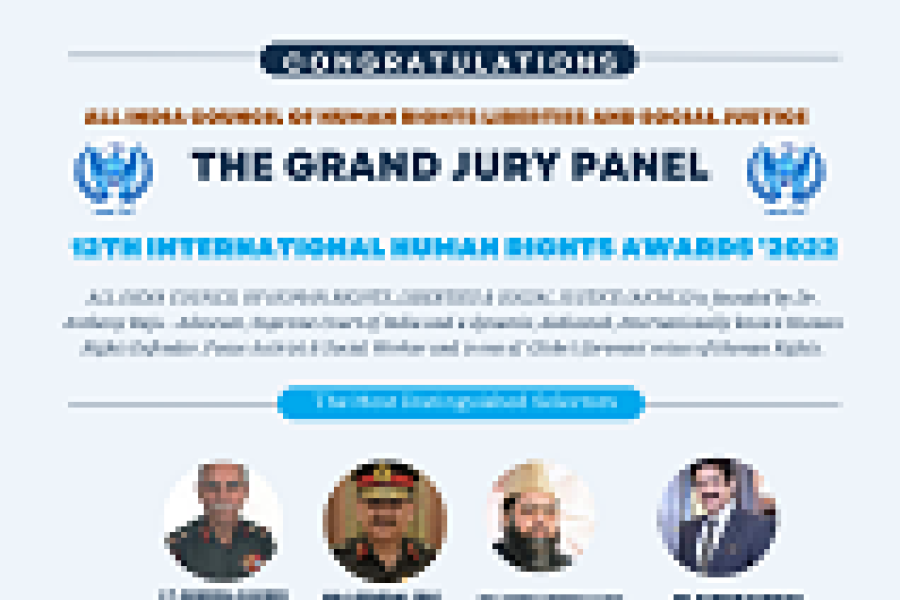
CONGRATULATIONS
TO THE GRAND JURY PANEL, FOR SELECTING THE MOST EMINENT AWARDEES FROM DIFFERENT WALKS OF LIFE, FOR THE 12TH INTERNATIONAL HUMAN RIGHTS AWARDS -2022
The most coveted institutional and prestigious Human Rights Award is given to individual’s/ world peace leaders / business leaders / institutions / organisations / corporates, who show exceptional leadership in the fight to protect and promote human rights and service to humanity. The award aims to promote the work of AICHLS & its wings.
Date, Time and Venue
December 10 '2022 at 5.00 pm, New Delhi – 110 003, With High Tea/Dinner
In Association with Mahabodhi International Meditation Centre Leh, AAFT University, Marwah Studio, Manav Rachna International School (Faridabad), International Human Rights Advisory Council (IHRAC), Indian Press Trust, Board of Global Ambassador for Human Rights and Peace (GAHRP), National Council Of News & Broadcasting (NCNB), Asian Human Rights Council (AHRC) , Amnesty Worldwide (AW) , Universal Mission For Peace And Harmony (UMPH) And International Press and Broadcasting Association (INBA) & International Council for Environmental Protection, Conservation Of Forests And Other Natural Resources.
With warm regards,
Dr. Anthony Raju
Advocate : Supreme Court of India.
Founder : "International Human Rights Awards"
Global Chairman : All India Council of Human Rights, Liberties & Social Justice.
International President : World Inter-Faith Council for Peace & Human Rights.
Chairman : International Institute for Human Rights Studies.
International Convener : International Press and Broadcasting Association
#dranthonyraju #drjuneann #drtessmartin #drameenaali #aparathapa, #sandeepmarwah, #humanrightsawards #Tophumanrightscouncil, #Humanrightsinindia #Socialjustice, #freelegalhelp #HumanRightsOrganizationsInIndia, #HumanRightsComplaint, #HumanRights, #AdvocateSupremeCourt #HumanRightsMembership ##TopHumanRightsOrganisationofIndia #peace #gahrc #humanrightseducation #humanrightsleadership #humanitarian #ihrac #dranthonyraju #aichls #humanrightsambassador #tophumanrightsactivistofindia #motivationalspeaker #inspirationalspeaker #nhrc #tophumanrightsadvocateof india #topcriminaladvocate #nationalhumanrightscommission #topcriminaladvocatesupremecourtofindia
"Human Rights In India,Social Justice,Human Rights Commission, National Human Rights Commission, Human Rights Organizations In India, State Human Rights Commission, Human Rights Commission Delhi, Human Rights Complaint, Human Rights, Advocate Supreme Court, Human Rights Membership, Top Human Rights Organisation of India" "Human Rights In India, Social Justice, Human Rights Commission, National Human Rights Commission, Human Rights Organizations In India,State Human Rights Commission, Human Rights Commission Delhi, Human Rights Complaint, Human Rights, Anthony Raju , Advocate Supreme Court, Human Rights Membership, Top Human Rights Organisation of India"
ALL INDIA COUNCIL OF HUMAN RIGHTS, LIBERTIES & SOCIAL JUSTICE (AICHLS) is founded by Dr. Anthony Raju - Advocate, Supreme Court of India and a dynamic, dedicated, Internationally accredited Human Rights Defender, Inspirational and spiritual speaker, Peace Activist & Social Worker and is one of Global's foremost voices of Human Rights.
Dr. Anthony Raju , who is an Internationally Reputed PEACE BUILDER, HUMAN RIGHTS DEFENDER , Diplomat , an Eminent Social Reformer & Activist, Environmentalist, Educator, Human Rights & Constitutional Rights Activists, Motivator, Change maker, Teacher Trainer, Disaster management Expert, Panel Arbitrator in National & International Level, Legal Aid Expert, Academician, Humanitarian works Expert, etc.
Dr. Anthony Raju has been awarded with several National & International Awards for his Excellence works for more than 10 Years for promoting and protecting Human Rights. He has been awarded with several (Honoris Causa) Degrees , Like Doctor of Sociology , Doctorate of Human Rights by International Peace University , Germany, PHD. Social Work by Universal Academy for Global Peace , Life time membership and Award by International Journalism Centre , National Human Rights Activist Award by All India Newspaper Association , Ambassador of Peace Award by Blind Association, Peace Ambassador by Global Peace Initiative -USA
Dr. Anthony Raju had justified his position many times against the capital punishment , he has publicly condemned this barbaric act in name of punishment. He has written number of articles on Extra Judicial Killings, Violence Against Women, Right to Education, Rights to Information Contemporary forms of slavery , Right to an adequate Standard of living, Extrajudicial, summary of arbitrary executions , Sale of Children, Child prostitution , Independence of Judges and Lawyers.
Dr. Anthony Raju spends most of the time between Tribal , underprivileged , Villages , he widely travels in various States i.e Orissa , Chhattisgarh, Jharkhand , Bihar , Uttar Pradesh , Madhya Pradesh , Uttrakhand , Gujarat , Rajasthan etc.


