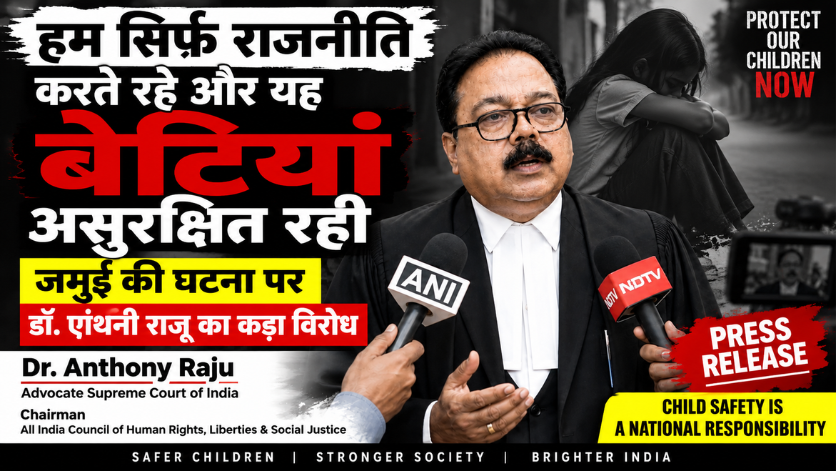
By Dr. Anthony Raju, Advocate Supreme Court
Section 376(2)(n) of the IPC criminalizes the act of repeated rape on the same woman, prescribing rigorous imprisonment of not less than ten years, extendable to life, along with fine.
Dr. Anthony Raju’s View:
This provision was introduced with the intent to curb heinous crimes, but over the years, it has also become one of the most abused sections of criminal law. A growing number of cases under 376(2)(n) arise not from sexual exploitation, but from consensual relationships that later turn sour. Law must punish the guilty, but it must also shield innocent men from false and motivated allegations.
The prosecution must establish three fundamental elements:
Sexual intercourse by the accused with the prosecutrix.
Such intercourse was without consent or under vitiated consent, such as fraud or coercion.
The act was committed repeatedly on the same woman.
Dr. Raju’s Observation:
In the absence of credible evidence showing lack of consent, the prosecution fails. A consensual relationship spanning weeks, months, or even years cannot suddenly be painted as rape merely because the relationship ends or marriage does not take place.
Consent is the strongest shield. When both parties willingly engage, the element of rape collapses. Courts have clarified that a failed promise of marriage is not rape unless it was false from the inception.
Dr. Raju’s Insight:
Time and again, the Supreme Court has said that consensual intimacy cannot be criminalized. To do so would be to trivialize the seriousness of rape and convert every broken relationship into a criminal case.
Delays and contradictions undermine the credibility of the prosecutrix.
Dr. Raju’s Comment:
Delay in filing complaint, unless satisfactorily explained, is a serious blow to the prosecution’s story. Courts are duty-bound to examine such delays with suspicion.
The absence of injuries or negative DNA evidence is a powerful defense.
Many complaints are lodged out of revenge, pressure, or financial disputes.
Dr. Raju’s Warning:
Misuse of rape laws is a reality we cannot ignore. While genuine victims deserve the strongest protection, false accusations must be met with equal judicial vigilance, for they destroy lives and erode faith in justice.
When both parties are mature adults in a consensual relationship, criminalizing the intimacy later is an abuse of process. High Courts have quashed such FIRs.
In cases where relationships break down amicably, courts have recognized that continued prosecution serves no purpose.
If the FIR does not disclose lack of consent, proceedings are liable to be quashed.
Courts can intervene where criminal law is weaponized for harassment.
Dr. Raju’s Perspective:
The High Court, under Section 482 CrPC, is the sentinel on the qui vive. It must protect citizens from malicious prosecution, and 376(2)(n) is no exception. A false allegation of rape is not just a personal attack—it is a crime against justice itself.
Pramod Suryabhan Pawar v. State of Maharashtra (2019, SC): Not every broken promise to marry is rape.
Dr. Dhruvaram Sonar v. State of Maharashtra (2018, SC): Love and passion do not amount to rape.
Uday v. State of Karnataka (2003, SC): Consent based on love cannot be equated with absence of consent.
Deepak Gulati v. State of Haryana (2013, SC): Distinction between genuine rape and failed relationships.
Anticipatory or Regular Bail: Stress consensual nature, contradictions, and absence of evidence.
Defense at Trial: Cross-examine prosecutrix on consent, contradictions, and delay.
Quashing (Sec. 482 CrPC): Show lack of rape ingredients, settlement, or malafide motives.
Dr. Raju’s Advice:
In defending false 376(2)(n) cases, the strategy must be firm and fearless. The defense should expose inconsistencies, highlight consent, and demonstrate malice. Bail must be sought aggressively, and quashing petitions should be filed wherever continuation of trial amounts to harassment.
Section 376(2)(n) was enacted to punish repeated sexual exploitation, but misuse is rampant. Courts have emphasized the need to balance women’s rights with protection of innocent men.
Dr. Anthony Raju’s Final View:
The justice system must not become a tool of vengeance. Every false case of rape weakens the fight of real victims. The law must be applied with caution, sensitivity, and strict adherence to evidence. Innocence should never be sacrificed at the altar of misplaced sympathy.
Enter your email address below and subscribe to our newsletter